Silent Ripening: Why Do We Wait to Harvest at Coto Bajo?

At Coto Bajo, we’re in no hurry to harvest. Discover why allowing the olives to ripen naturally in October and respecting natural cycles are the key to producing an extra virgin olive oil of exceptional quality.

INDEX

While in other regions the machines are already running at full capacity, an apparent calm reigns in Coto Bajo. A stroll through our olive groves in October allows you to witness the olives ripening in their purest form. In this post, we’ll explain why we’re in no hurry and how that wait results in a complexity of nuances that can only be achieved by respecting nature’s rhythm.

Lipogenesis in Olive Ripening

Inside each fruit, an amazing chemical process is taking place that is closely linked to the ripening of the olive: lipogenesis, or oil formation. Throughout the month of October, the olive continues to convert the sugars produced by photosynthesis into high-quality fatty acids.

At Coto Bajo, we monitor this process weekly. We do not seek maximum yield (more liters), but rather the exact point of olive ripeness where oleic acid and the aromatic precursors are at their peak. Waiting a few more days can mean the difference between an average oil and an exceptional one.
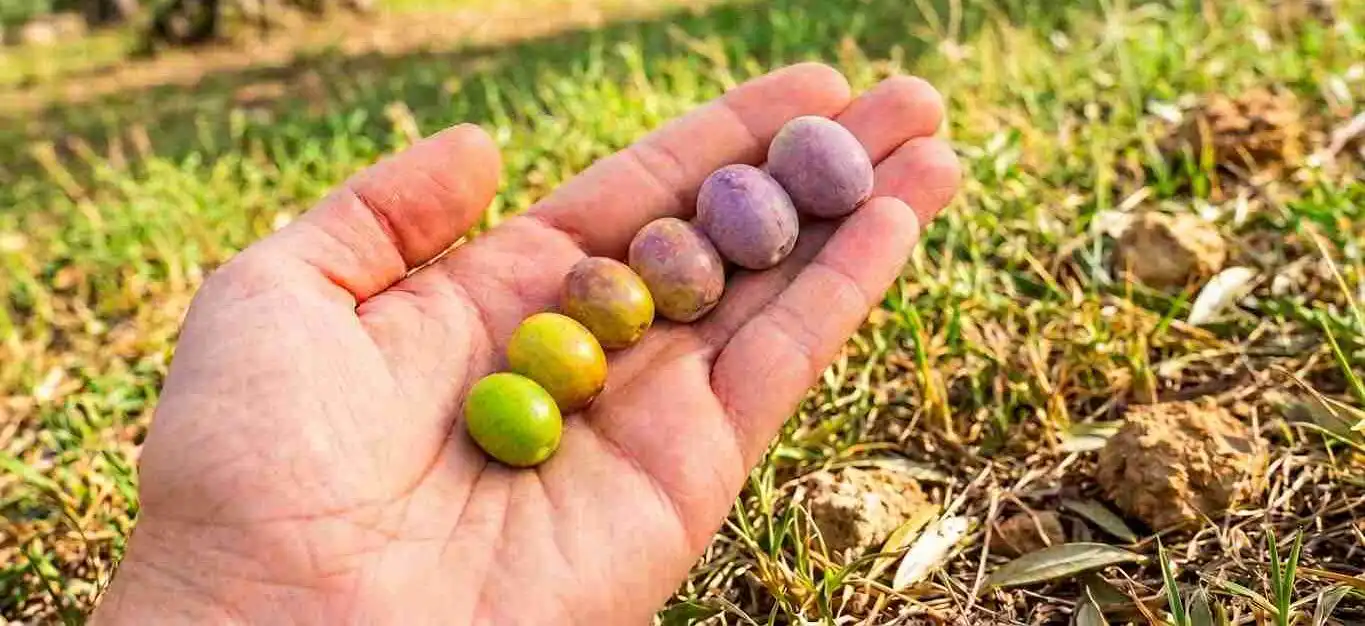
Olivar en Septiembre: Escala de colores en aceitunas durante el envero Coto Bajo

The Climate and Orientation of Our Farm: A Decisive Factor

Our location directly influences the agricultural calendar. The orientation of our plots and the gentle breeze from the countryside allow the olives to ripen at their own pace, more leisurely than on intensive farms. This slow ripening process allows the aromatic compounds to settle, giving our extra virgin olive oil its distinctive character.

Learn more:

Featured Read: This personalized management of each plot is what defines us as a farm-direct olive oil. If you’d like to learn more about how we monitor every step of the process, check out our post on traceability and our in-house mill.

Green or Purple? The Color Dilemma

Many people associate quality solely with a bright green color. However, in varieties such as our Pajarera or Arbequina, allowing the olives to ripen properly until the onset of veraison (when purple hues appear) enables us to mellow certain excessive bitterness. As a result, we find more complex notes of ripe fruit without losing the initial freshness. It’s all about finding the perfect balance.

Patience as an Ingredient of Quality

In a world that’s always on the go, here at Coto Bajo we’ve decided to slow down. We know that the harvest will take place in late November and December, so we’re using this time to prepare the winery and make sure everything is in perfect order. Patience is, perhaps, our most valuable ingredient.

Did you know that… Respectfor these natural cycles is the foundation of our organic certification. You can read more about how we care for the ecosystem in our post on the importance of olive groves for biodiversity.

Reading Material for a Productive Wait

To make the wait for the new olive oil go by faster, we recommend:

Excellence knows no haste. At Coto Bajo, we continue to care for each olive as it ripens so that, when the time comes to press them, the result will be unforgettable. While we await the new harvest, we invite you to enjoy our current selection, which is at its peak of maturity and balance.

Discover our extra virgin olive oils by visiting our store.

You may also be interested in

hojas de olivo
Silent Ripening: Why Do We Wait to Harvest at Coto Bajo?
At Coto Bajo, we’re in no hurry to harvest. Discover why allowing the olives to ripen naturally in October and respecting natural cycles are the key to producing an extra virgin olive oil of exceptional quality.
The Olive Grove in September: Active Preparation for the Harvest
In September, the olive grove undergoes a series of changes. The veraison signals the imminent harvest. Learn how we prepare at Coto Bajo to ensure everything is ready for the production of this season’s EVOO.
What Exactly Is Single-Estate Olive Oil? Traceability and Soul at Coto Bajo
In contrast to industrial production, Coto Bajo Estate Olive Oil embodies a single-estate model in which the product is grown, processed, and bottled on the same property. By eliminating middlemen and committing to organic farming, we guarantee radical traceability and immediate milling. The result is an EVOO of maximum freshness, where varieties such as Picual and Pajarera express the unique identity of their terroir, prioritizing health, sustainability, and authentic flavor.
Extra Virgin Olive Oil: A Staple of Summer Cooking at Coto Bajo
Discover why extra virgin olive oil is your best friend in the summer kitchen. Learn how to pair it with your fresh dishes, find out about its benefits in the sun, and learn how to protect it from the heat.