
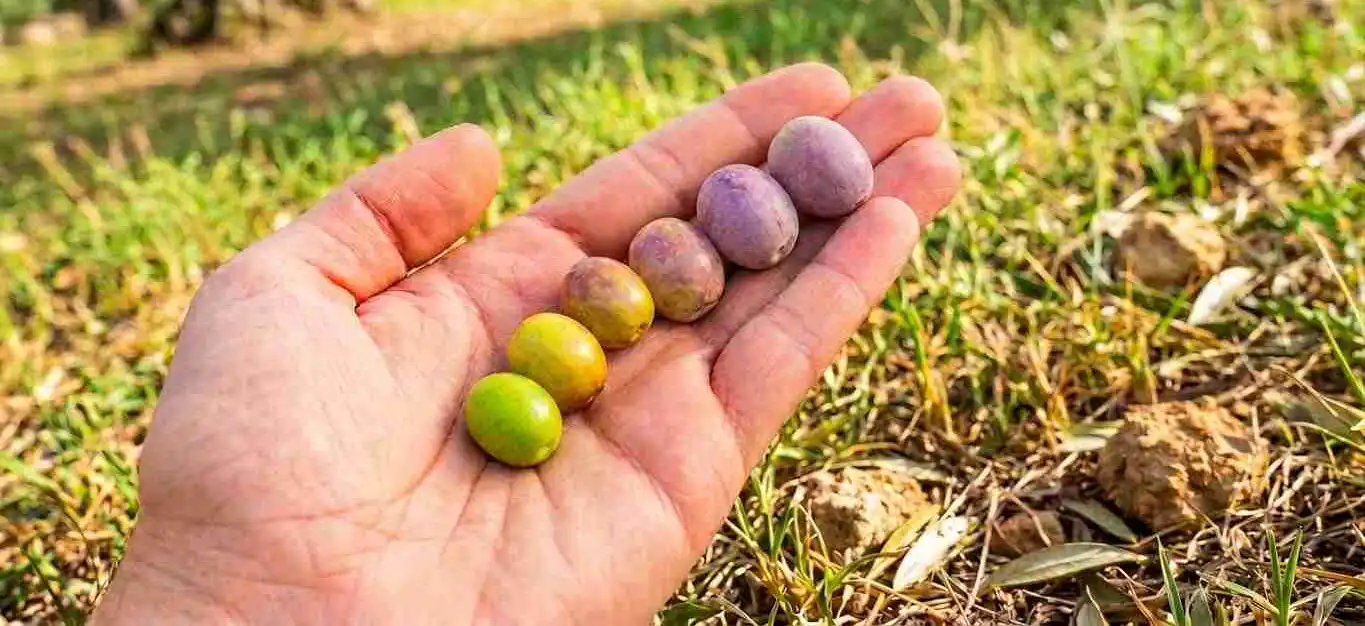
September isn’t a month of rest in the olive grove. It’s the month of observation. As the heat subsides slightly, our farmers walk through every plot at Coto Bajo to monitor a fascinating visual and biological phenomenon: veraison. This change in the olive’s color—from deep green to purple—marks the start of the countdown to our harvest.
Understanding what it means for an oil to be produced, aged, and bottled in the same place is essential to appreciating the culinary gem that arrives at your table.
Veraison is the ripening process during which the olive stops accumulating chlorophyll and begins to synthesize anthocyanins. At Coto Bajo, we don’t wait for the fruit to ripen completely. We look for that exact moment when the olive is “enverada,” with yellowish and purplish hues.
Why? Because this is when the herbaceous aromas and polyphenols are at their peak. Determining the exact start date is almost an art form that combines field experience with laboratory analysis.
People often ask us why we start harvesting when the oil yield is still low. The answer is simple: for the taste and for health reasons.
A ripe (black) olive yields more oil, but the oil is less complex and contains fewer antioxidants. By harvesting early, we obtain fewer liters per kilogram of olives, but the resulting juice is an explosion of freshness, with notes of freshly cut grass and much greater stability.
Learn more:
This commitment to the highest quality is the foundation of our philosophy. If you’d like to better understand how the cultivation process influences the final product, we recommend reading our post on the environmental impact and sustainability of EVOO production.
In September, the olive grove undergoes a transformation. While all of our varieties are important, in September the Picual tends to be the focus of our conversations. This variety is particularly rewarding in the early harvest, offering a very balanced sensory profile: sweet on the palate, with an elegant spiciness and an aroma reminiscent of almonds, bananas, and tomatoes.
It is a hardy variety that symbolizes the versatility of our farm and benefits greatly from this month’s transitional weather.
You’ll definitely want to check this out: Best oil for frying: a healthy guide featuring Coto Bajo EVOO.
While we’re out in the fields inspecting the olives, we’re conducting the final machinery tests at the Coto Bajo oil mill. Since we produce estate-grown olive oil, our mill is just a few meters from the olive trees. This ensures that, once we decide to begin, the time from when the olives are picked from the tree until they are turned into oil is just a few hours.
This complete control is what allows us to maintain the cold chain and ensure that the volatile aromas are not lost during transport.
Did you know that… The oil we harvest during these first few weeks of the season is the richest in therapeutic properties. We already mentioned this in our article on how EVOO can help alleviate allergy symptoms, thanks to its powerful natural anti-inflammatory properties.
In this post, we wanted to describe the changes taking place in our olive grove in September. If you’re passionate about early harvesting, we recommend these articles from our blog:
Have you tried pairing our Picual EVOO with a seasonal garden tomato yet? We promise you won’t need anything else to achieve perfection. Discover our extra virgin olive oils by visiting our store.

